New publication in Science: A single freeze cycle redirects iron mineral transformation
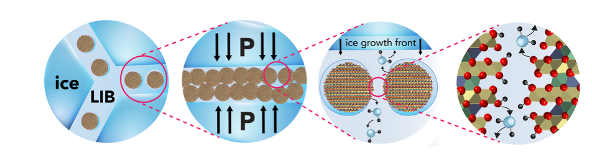
A single freeze–thaw cycle permanently reorganizes ferrihydrite nanoparticles, redirecting their long-term transformation from goethite toward hematite. By showing that freezing actively reshapes mineral interfaces through confinement and interfacial bonding, this work establishes ice as a geochemical reactor with important implications for iron cycling, contaminant fate, and paleoclimate reconstruction.
A single freeze cycle redirects iron mineral transformation
A single freeze cycle redirects iron mineral transformation
Tao Luo , Tao Chen , Tra My Bui Thi , James Behan , Crispin Hetherington , Khalil Hanna , Jean-François Boily
Science, 393 212-216 (2026)
Polycrystalline ice formation concentrates mineral nanoparticles into liquid boundaries between growing ice crystals. Here we show that minutes of freezing dictate iron mineral fate over subsequent months of aqueous aging. A single freeze–thaw cycle irreversibly aggregates ferrihydrite through converging physical and chemical mechanisms. Freeze concentration collapses electrostatic barriers while cryosuction strips hydration layers and compresses nanoparticles into micrometer-scale planar aggregates. Chemical evidence points to interfacial (hydr)oxo bridging, alongside hydrogen bonding, that resists disaggregation. These mechanisms lock nanoparticles into mesocrystal-like assemblages that retain their nanoscale identity but inhibit dissolution–reprecipitation to goethite, instead favoring solid-state transformation to hematite. Ice formation thus acts as a geochemical reactor, driving aggregation and interfacial bonding that redirect iron speciation, with broad implications for nutrient cycling and carbon preservation across the cryosphere. Ferrihydrite is the main reactive iron phase in glacial environments, influencing iron bioavailability and carbon preservation at high latitudes. Little is known about how its reactivity changes during freezing and thawing. Luo et al. subjected suspensions of ferrihydrite to 24-hour freeze-thaw cycles. They found that after one cycle, ferrihydrite had irreversibly aggregated into micrometer-scale sheets, their shape reflecting assembly within the confines of ice’s intergrain liquid films (see the Perspective by Rosso). Aging experiments showed that this configuration puts ferrihydrite on a transformation path to hematite rather than goethite, with implications for photoreductive iron cycling and carbon-contaminant sorption in seasonally frozen soils and permafrost. —Angela Hessler


